Hold for a moment and just witness your surroundings, your own actions and lifestyle, how things have evolved. If you need medical treatment, you need to first go directly to a doctor's clinic and hospital and ask the staff.
If you want to know how the product sustains its quality, what the price of the product is for everything you had to visit in person, but now the scene is twisted, and the world has evolved so far.
When the world is undergoing transformation, websites must be stronger and smarter because humans are not the only users accessing information on the web; AI agents often visit them as well.
Humans can see the buttons, visuals, content, and navigation, and know what action to take next and where in the process to do what. But AI agents or AI agent systems cannot do that until they are trained or built to perform specific tasks.
If you prefer the same curve and approach, that’s not enough now because we use AI agents/ assistants and AI tools, so it's highly important to design websites for AI agents' accessibility along with human behavior.
AI agents can interpret information, HTML elements, and metadata, but for dynamic content driven by JS events and navigation to explore content or make purchases, AI agents must be able to perform meaningful actions.
If the website is built around only human behavior, AI agents will face the following challenges:
- Lack of understanding of a button or form element
- Can't interpret interactive dynamic elements
- Hard to traverse the multi-step process goals
- Website structure isn’t uniform, which makes it difficult for an AI agent to understand the interface
Thus, to drive convenience and efficiency in our daily life to understand what the website says and visualize, the website must be developed with AI capabilities, which significantly raises the importance of webMCP in the digital world.
Here, in this blog, we explain the webMCP server and its mechanism, along with a guide to build a website agent ready with webMCP.
Understanding Concept: What is WebMCP?
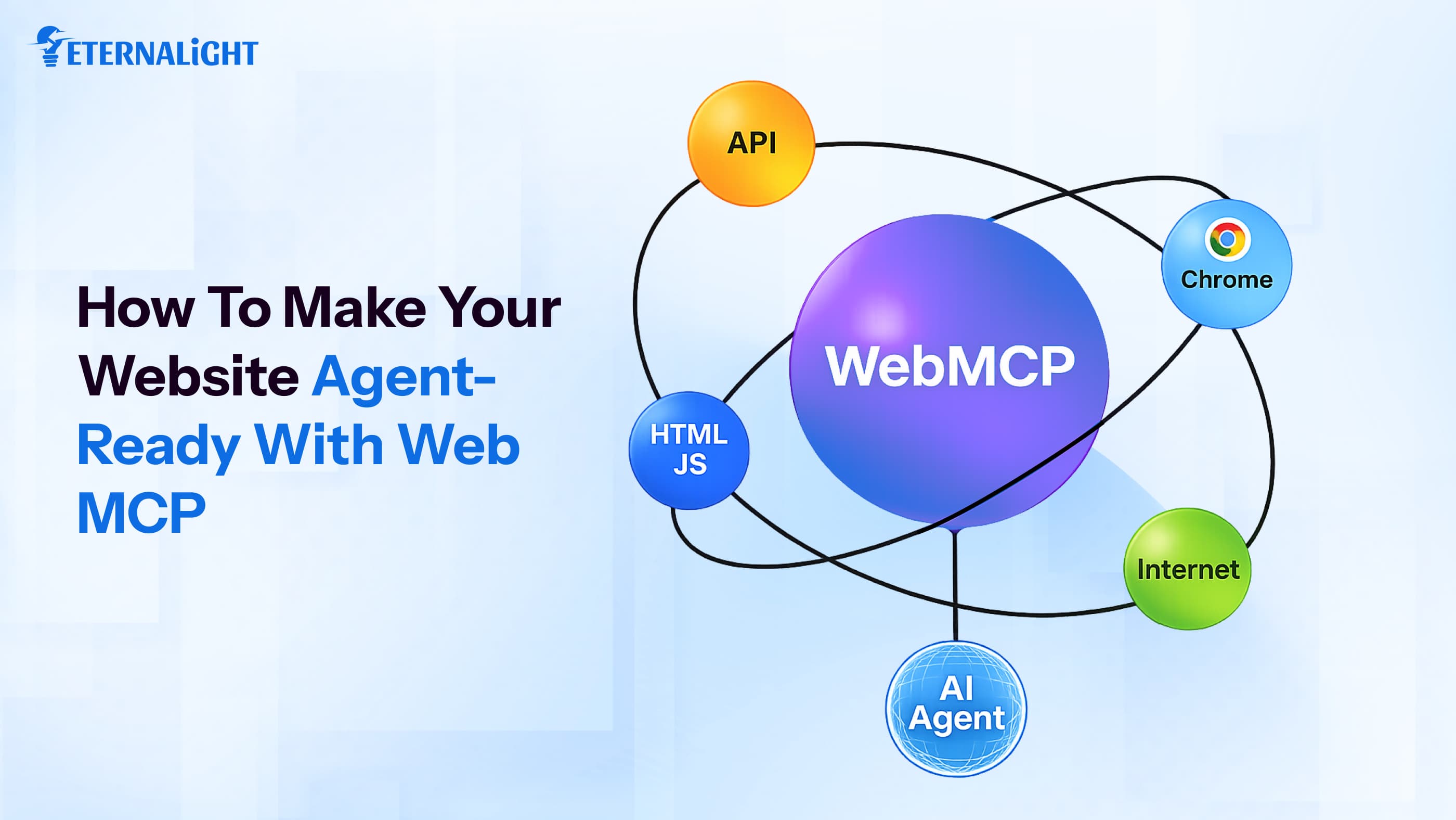
WebMCP is like a communication layer between a website and AI agents, extending their capabilities to understand essential actions to perform rather than just opening the web page. It’s a kind of structured web model context protocol that can interpret the visual dynamic interfaces for machines and AI systems.
We don’t need to integrate any additional AI tools to make the website AI-ready. WebMCP simply exposes the available actions and workflows so AI agents can interact with the website more accurately and efficiently.
Why Does WebMCP Matter for Businesses?
From visiting the physical hospital and clinics to asking an AI assistant to schedule an appointment or demo, to filling out the form, we just experience convenience, efficiency, and automation. AI assistants have all the essential capabilities to manage tasks online; they can understand content and act autonomously, demonstrating human-like decision-making.
Many industry domains have adopted AI agents across organizational workflows, improving the customer experience. AI agents can’t perform the task successfully until websites expose capabilities for understanding context. webMCP is essential to enable the flow, reliability, and speed to explore websites in a structured way across multi-step tasks.
How Do AI Agents Access Websites Today?
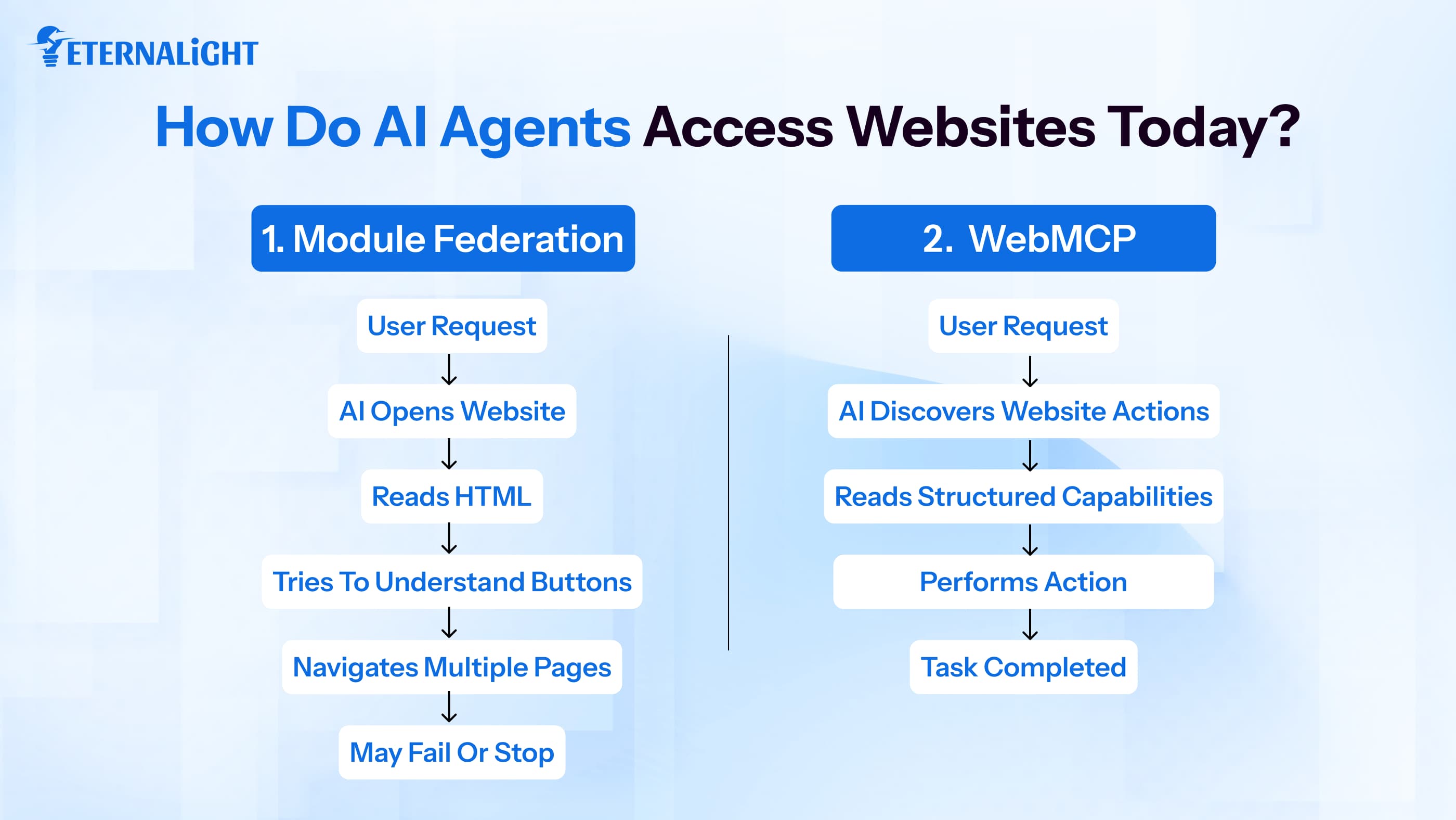
We already briefly shared that AI agents interact with the website differently than humans. These are actually systems and machines, so they don’t know where the button will redirect to, what input needs to be entered in form fields, or which option to click next in the navbar menu. But humans know that, and that's why they can make decisions just by seeing visuals, as they know where the page or screen will open next.
AI agents understand the metadata, structure, and doctype, but modern websites are built using AI tools, so there’s much more hidden, such as popups, alerts, and interactive multi-step interface tours, so it's a bit more complex.
Let’s understand with an example:
If we book a hotel room through an AI assistant without WebMCP, an agent needs to understand all the buttons and form fields, and navigate through different screens to complete the booking steps. If the website isn’t structured according to the agents' requirements, interpreting the information isn’t possible, leading to interrupted bookings. That’s why it's important to design web interfaces around AI.
It’s so all-consuming: if a human inputs something, an AI tool responds and asks for the next action to be performed. Now, with the emergence of WebMCP, they don’t need to analyze HTML elements or visuals to know what it is. They can get clear directions on all actions and tools, ensuring reliability across every interaction on the website.
AI agents can identify every event it invokes, whether it’s hitting the schedule consultation button, submitting the form after filling it out, or initiating a payment or refund. They can identify all independently without relying on anyone; no guesswork needed to click or navigate to other sections or screens.
WebMCP structures the website for AI agents to reduce time and steps for a more rapid workflow completion, enabling owners to focus on other work in the meantime.
How Does WebMCP Work?
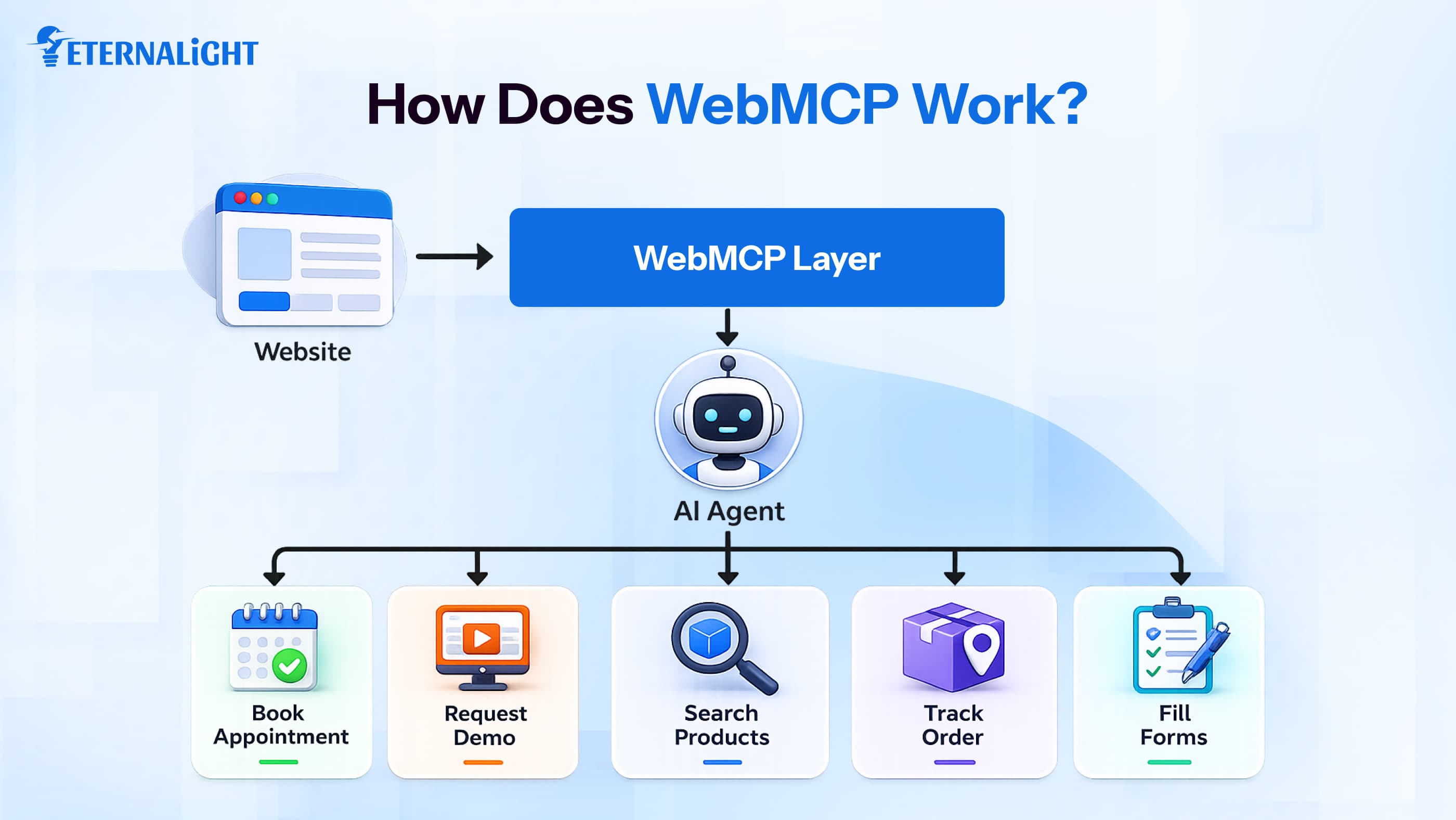
WebMCP interprets the website information and its user interface in a structured, machine-readable format so the AI agents can easily access all the visuals and JS-driven components to perform future moves, interact with the website, and perform more actions such as:
- Request the quotation/ appointment
- Submitting form
- Request demo
- Product discovery
- Order details/ tracking
If at some point the user is absent, these AI agents can populate the required details into the exact placeholders and text bar, take action to proceed, and revise the stored responses without human intervention or any additional tool exposure.
Here, we are not transforming the entire website; we’re just establishing the communication layer so that AI agents can interact with it alongside human users.
Step-by-Step: How to Make Your Website Agent-Ready with WebMCP
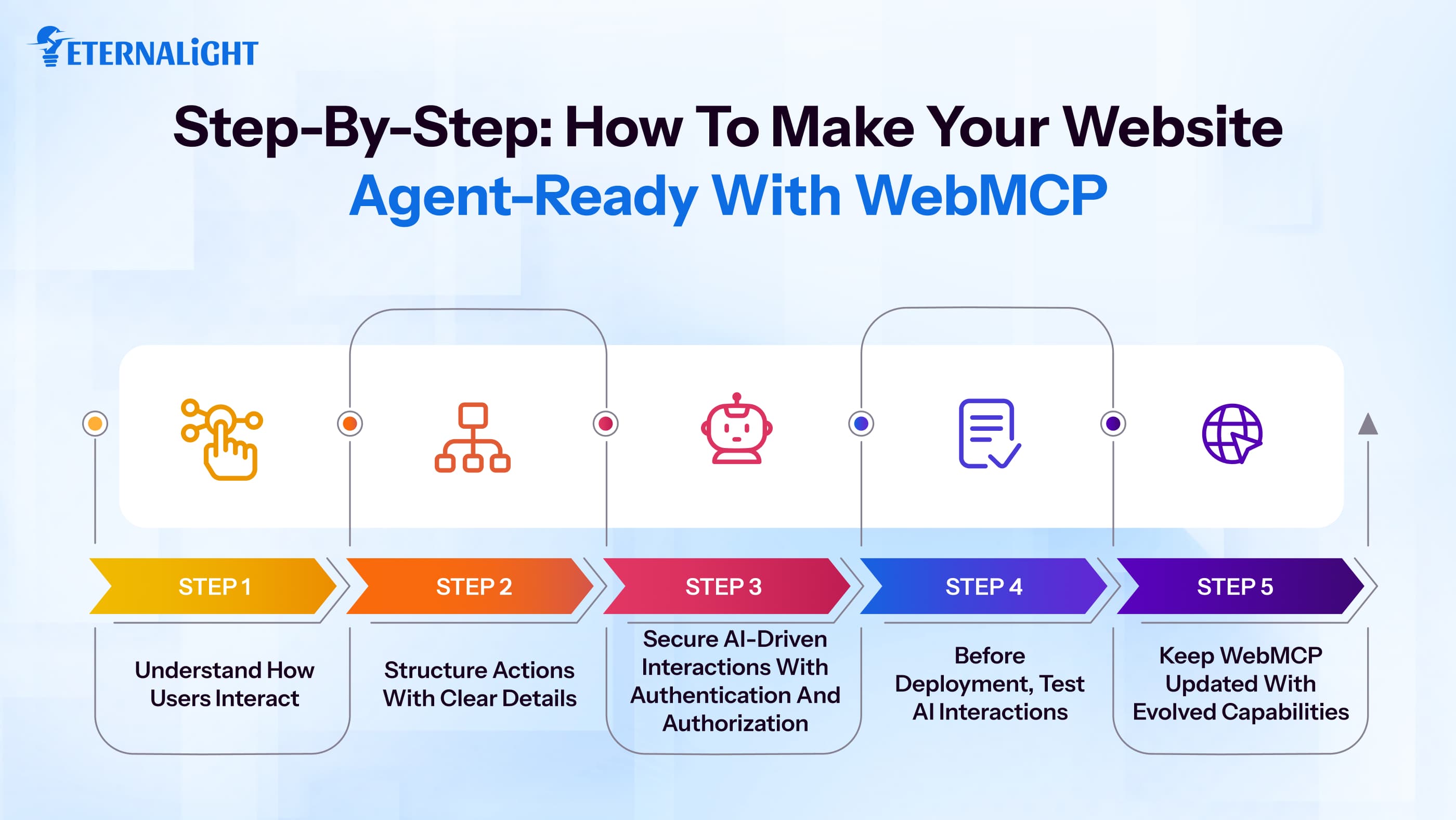
We are not saying that all the efforts and time you invested in building a website are of no use, but you just need to add an additional block for an AI agent. Implementing WebMCP on your website will make your website ready for AI agents and enable meaningful interactions. No matter what kind of website it is or what industry it's in, following the steps to set up WebMCP will make things easier.
Understand How Users Interact
Generally, users visit any website for appointment booking, product demo, product discovery, to fill and submit a form, or order tracking.
Humans can understand the actions and perform the required moves, but agents must be able to do the same.
Structure Actions with Clear Details
You can’t expect an AI agent to automatically understand the website icons and graphic elements or touchpoints. It is essential to provide detailed information about actions, responses, validations, permissions, and other authentication.
Secure AI-Driven Interactions with Authentication and Authorization
Your website must have sensitive information and data that need to be hidden from AI agents. To manage secure interactions, implement authentication & authorization rules. Apply limits, role-based controls, and input validations.
Before Deployment, Test AI Interactions
Testing is indeed before deployment. Don’t sit after implementing the webMCP test and assume the AI agents are interacting properly or that there are no bottlenecks that need to be resolved before they access your website.
- Check if the AI agent can discover all actions,
- Have an understanding of inputs as per requirement
- Handle workflow without disturbance
- Tackle the technical errors independently
- Generate accurate responses as per input
Keep WebMCP Updated with Evolved Capabilities
Websites are not the same as they used to be. It evolves according to the needs of users over time, so to access the updated information, an AI agent must have essential capabilities. Don’t forget to review and make the changes to your WebMCP to get reliable, accurate responses and interactions.
Real-world Use Cases of WebMCP
WebMCP has recently been introduced across the dev world, and the industries are impressed with its implementation. It reduces the friction and communication gap, enabling digital interactions to be more reliable and secure.
In Healthcare: Online consultation, specialist search, time slot, patient record, prescription
Ecommerce: Product search, availability, wishlist, order, best deal seal, and completing details for finalizing purchase
Hotel/ Travel: Exploring stay, accommodation and booking, tickets, comparing prices, finalizing itineraries
Banking/ Finance: Exploring plan options, navigating pages, checking credit score and eligibility for services with all authentication
Saas Enterprises: Booking demo, onboarding query support, documentation on demand, subscription plan
Challenges of Implementing WebMCP
WebMCP is in its infancy, and its full potential has yet to be unlocked. As there is less awareness that AI agents interact with websites differently, challenges also lie.
- A few websites and AI platforms find it difficult to adopt.
- Additional effort and time are needed to structure the website using the resources to clarify the website actions.
- Some security and permissions need to be hidden, and essential ones need to be granted for authorized processes and actions.
- Future advancement seems more critical to adopt
Is It the Right Time to Adopt WebMCP?
WebMCP is not mature, but the direction is clear. The industry has moved on from generic chatbots to Agentic AI, and AI agents are already in the industry.
So now, instead of generic, rule-based conversations, AI agents are interacting with browsers and websites, discovering new opportunities with each passing month.
From booking appointments and auditing accounts to handling customer queries and orders, WebMCP enables AI agents to interact more comfortably in the future.
The difference isn’t evident on many generic websites, but it’s still better to be prepared for the trend and technological evolution.
Conclusion
The digital world is evolving with the recent evolution of AI agents. The digital world is evolving with the rise of AI agents. From booking appointments and requesting demos to completing purchases and handling customer support, AI agents are gradually becoming another way people interact with websites. WebMCP provides a structured communication layer that helps websites expose their capabilities, allowing AI agents to understand and perform actions more reliably.
While WebMCP is still evolving, businesses should start preparing their websites for AI-powered interactions alongside human users.
Building an agent-ready website isn't just about adopting a new protocol; it's about preparing for the future of the web, where AI agents and humans will interact with websites together.

Ayushi Shrivastava
Senior Content Writer
Ayushi is a Content Strategist at Eternalight Infotech with 4 years of experience in transforming complex ideas into clear, engaging, and SEO optimized narratives. She specializes in crafting impactful content strategies that enhance brand visibility and drive meaningful engagement across digital platforms.
Related Blogs
- AI & ML7 Mins
Best Prompt Engineering Techniques for AI Agent Systems
Explore prompt engineering techniques for different AI use cases, including structured prompts, zero-shot, few-shot, multimodal inputs, security, and testing.
- AI & ML10 Mins
AI Doesn't Forget. It Loses Context: How Context Graphs Can Help
Learn how context graphs help AI agents connect information, retain context, and make better decisions with AI memory tools and retrieval systems.
- AI & ML10 Mins
How to Test Generative AI Applications: A Practical Guide to Reliable AI Systems
Learn how to test generative AI applications for accuracy, hallucinations, performance, security, RAG workflows, and reliability.