Organizational teams in startups and enterprises use AI tools to work faster. Some tools are free; some are paid. Generally, free versions lack some capabilities, so teams subscribe to a plan to access more. After some time, every tool gets an upgrade, or new tools with the same benefits launch in the market; this creates confusion about which tool we should use or which we should avoid for shaping products with engineering intelligence.
To try different tools, teams pay for each one and then forget after some time. It accumulates extra budget. Without understanding the true context, it's a total waste. It not only wastes money, but also consumes system memory, and if the tools are open source, they may contain viruses or malicious objects. Governance standards drive some tools, while others have no license.
Some companies build their own tools or train models, but they only want to showcase their services; the context is still missing. It may reduce the cost they pay to others. Even if they add an AI layer, it will drive efficiency, but the question and problem remain: how do you engineer intelligence into digital products?
Do we need to rely on tools and spend time building and training models?
The blog covers this dilemma to help you decide.
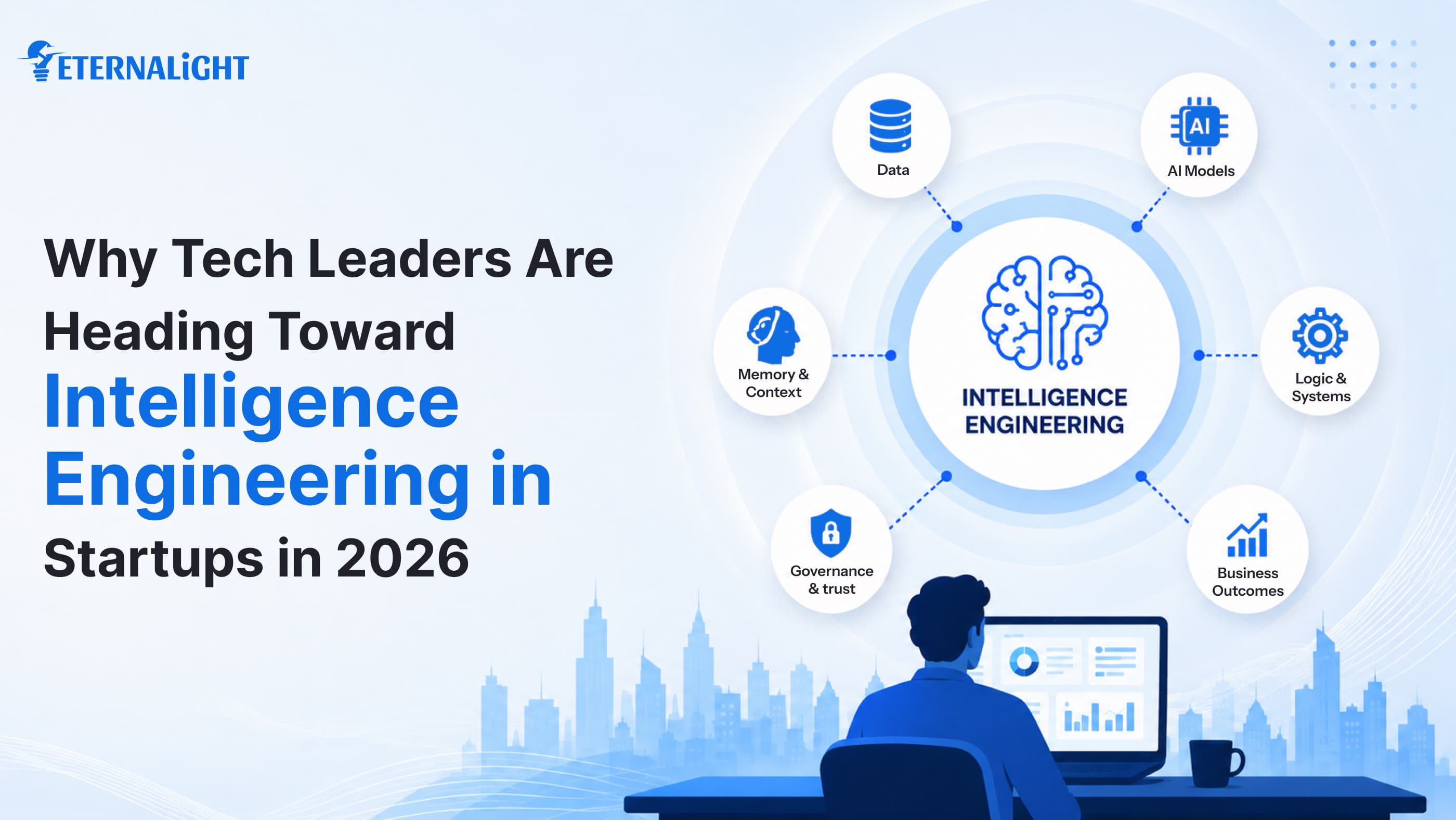
What is Intelligence Engineering?
To measure business progress, the number of AI tools is not the primary KPI. In an organization, different cross-functional teams and employees work on different tasks. Some organizations can adopt tools based on their needs and convenience, while others have HR or IT install a set list of tools.
When employees don't know which tools are widely used for operational workflows, it creates a problem. A healthier approach is to collaborate with all team members and ask which tools they use for their work. Are they licensed and approved by the organization?
They should access other tools that can disrupt growth and enable growth-driven outcomes. Intelligence engineering isn't about adopting trending AI tools and models; it's about how those AI automation tools reduce business issues and improve productivity and efficiency.
Intelligence Engineering Architecture at a Glance
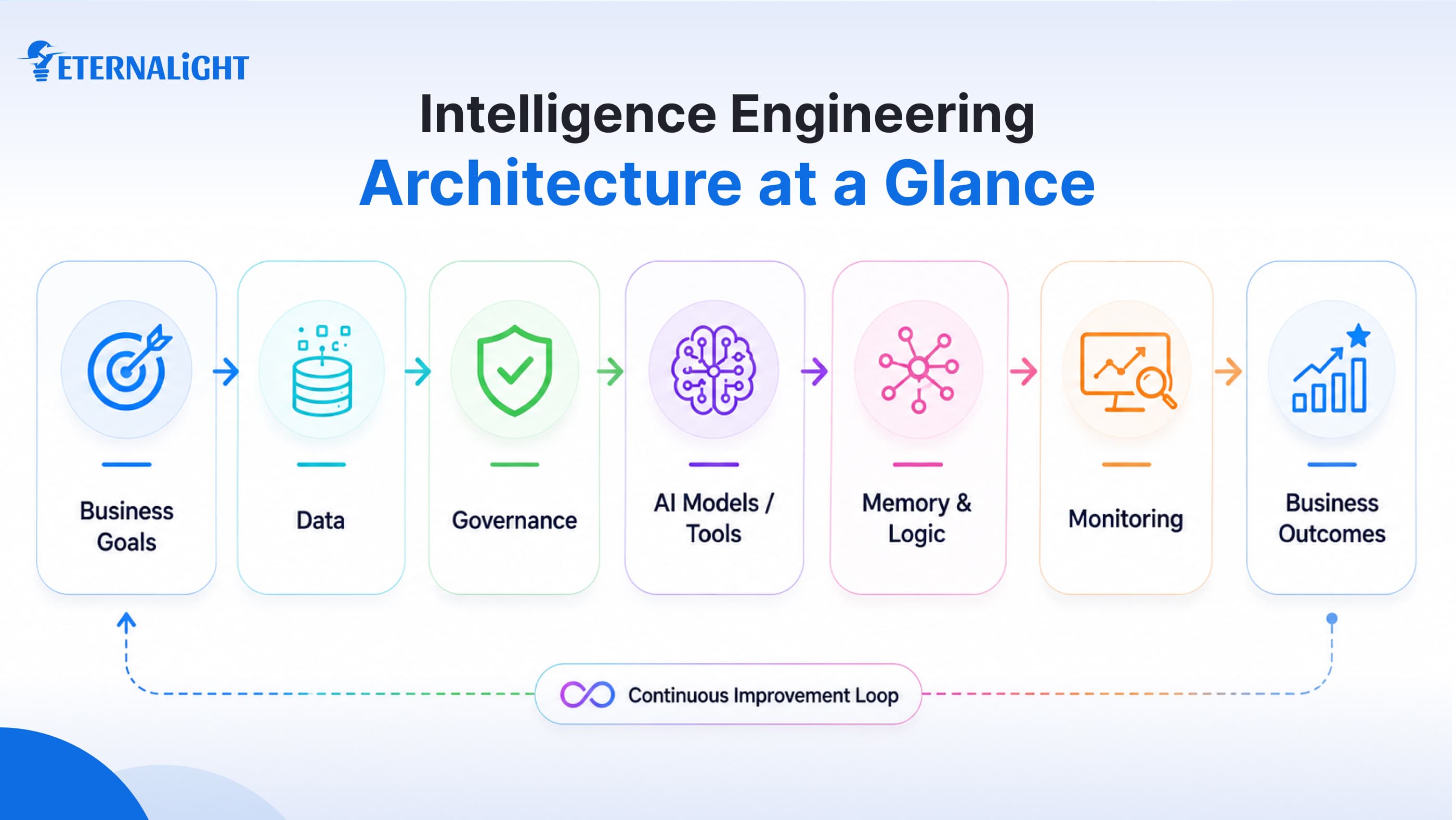
When software development teams get the idea, they don't think much about advanced things; their priority is to turn the client's expectations into an app or model. They have an enormous amount of data, integrations, and libraries. Everything is about engineering the best product that real users can adopt. The engineering is there, but the core is backed by what users want.
There’s a slight difference between engineering and intelligence engineering. It comes from utmost dedication and discipline, with defined governance, policies, business logic, and scalable infrastructure, connected with wisely chosen tools.
An organization has a team of a CTO, CFO, and marketing manager, and everyone is open to sharing their opinion; even the cross-functional development team is asked to share their views on how to build an intelligent AI model without unnecessary integration and access to libraries. A diverse team researching first from all perspectives- how the data is filtered, fed, and forwarded to the models with proper memory management- can reduce uncertainty and financial debt.
- If a system fails to manage data, monitor it, and produce relevant output, it's a failure and can turn into a disaster, so observation is a must.
- Before subscribing to any tool or model, inspect their offering; don’t just fall for pricing in a rush.
- Ensure the team isn't accessing raw, unfiltered information or non-compliant resources. Models must be aware of the semantic layer and governance.
Why AI Models Alone Aren't Enough
Using AI tools and models isn’t the problem anymore. Tech leaders who use these capabilities effectively make strategic decisions and deliver greater business value. These tools offer better recommendations and new ways to unlock growth possibilities, but relying 100% on them can create negative value. Some tools can access sensitive information, compromising security and speed, and generating false results.
We love to explore and experiment with new things. Carrying this mindset across business operations, tech leaders adopted high-level AI-driven tools, agentic AI systems, and LLM models, giving them the training to scale, but they still cannot outperform competitors. Engineering new models and tools isn’t the goal now; they must use intelligence to determine what actually needs to be done to scale enterprise solutions.
For 20+ years, the tech industry has incorporated AI to drive automation, efficiency, and accuracy. Everyone thought mastering multiple tools was worth it. To strengthen their enterprise presence over competitors, tech leaders spent time scaling capabilities, defining new KPIs, updating versions, and exploring industry trends.
Every second, new things launch, intending to take the lead and achieve sustainable growth. But how does it enable purposeful alignment in context and drive the value that matters most to tech leaders?
How Does Intelligence Engineering Change AI Product Development?

Intelligence isn’t in vibe coding or deploying new AI models or tools; it's in improving robustness and reliability through the right engineering effort. If steps are taken wisely, then it will drive major transformation across the enterprise.
Evolution Instead of Rigid Single-time Deployment
Enterprises can build and launch AI agent applications and models easily, but maintaining efficiency and accuracy while generating value-driven responses is difficult. To do that, they must measure and observe real-time behavior and patterns while applying governance rules. Make sure models can access, store, and generate information that continuously aligns with user inputs and business goals.
Businesses need to strengthen data pipelines and other performance metrics to avoid disruptions and maintain intelligence.
Engineering AI Models isn’t a Project But a Discipline
The problem lies in every business: smoothly navigating the complex scenarios and struggles organizations face when taking AI initiatives.
AI is a layer implemented in any project; it doesn’t define the final project deliverable.
Not every business aspires to the same goals and objectives; the strategy will differ. Security standards, guidelines, efficiency levels, and data sources will vary. Instead of launching AI tools with isolated layer integration, the tool and models must embed essentials.
Adopt a Shareable, Reusable Codebase at Enterprise Scale
A startup and an enterprise operate in different domains, managing logistics, finance, marketing, tech-related deployment, and more. If they use different tools for different things, it will cause confusion and a financial burden. It's hard to inspect and observe everything in isolation.
To manage things responsibly, it's better to engineer tools and models through a single, shareable codebase where engineers can focus on a uniform programming language, resources, reusable components, APIs, integrations, and frameworks like n8n, LangChain, and LangGraph, saving time, effort, and infrastructure costs.
AI is Just a Standard to Improve Business Value
Now, the focus isn't on what's new in the market as a tech stack or which company is launching next, but whether those experiments and launches are worth it for enterprise and startup growth. Are the AI models connected to reliable data sources, compliant with AI governance, and capable of scaling further?
Why Intelligence Engineering Matters for Businesses
The enterprise discussion is not about securing funding for AI deployment. The priority is shifting attention to proper execution that can drive growth, even for pilot projects. Tech leaders are brainstorming to prepare a sophisticated plan with technical brilliance. They are not only focusing on building new models but also on embedding relevant, reliable functionalities in new, innovative ways.
Decision-making Before Every AI Purchase or Build
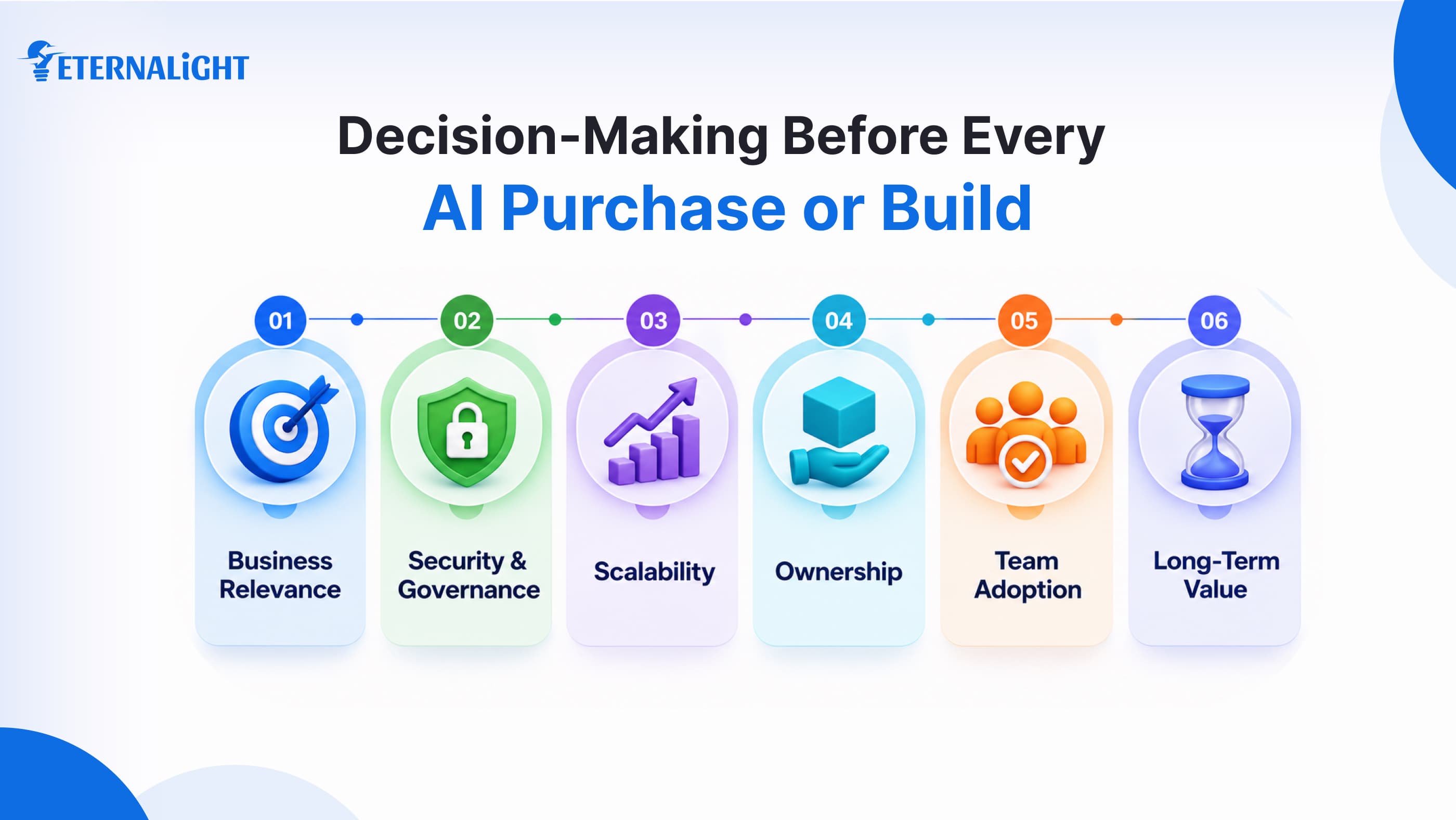
Tech leaders can’t win and stay ahead of competitors by having a large stack of AI tools. The context must be clear: why they’re buying or building AI models.
They must understand the existing problem in depth. This observation is a must; understanding AI governance is also important.
Whatever is in production as an AI model must have a database and memory space to store proper inputs and processes, and also have reasoning capabilities. Team members must be involved in every discussion when purchasing anything for the organization, so the team can decide whether the architecture is scalable and whether the vendor is good.
Every penny you invest matters, so the following things need to be considered for engineering intelligence at products:
- Is the AI model relevant to the business in any context?
- Is it just to adopt AI and chase competitive advantage, or actually resolve the business problems
- Who controls the AI system?
- Is the system allowed to make changes and to take further initiatives?
- Can this AI model become the voice of the regulator and user about the system’s capability? Do we know why we made the investment and what led to the decision?
- Can we redo the investment after a year without considering whether more team members will use the tool? Is it feasible?
Conclusion
The future of software engineering isn’t about the count of models but about strengthening the business reputation with strict AI standards and foundational blocks. When AI and business intelligence combine, they drive consistency and competitive returns. Now the main goal isn't product engineering with AI capabilities, but to level up intelligence through continuous evolution. If you want expert support for AI development to engineer enterprise-grade products, talk with our team about hiring software developers.

Ayushi Shrivastava
Senior Content Writer
Ayushi is a Content Strategist at Eternalight Infotech with 4 years of experience in transforming complex ideas into clear, engaging, and SEO optimized narratives. She specializes in crafting impactful content strategies that enhance brand visibility and drive meaningful engagement across digital platforms.
Related Blogs
 Software Development9 Mins
Why Choose Python for Fintech App Development?
Learn how Python helps fintech businesses build scalable, data-driven applications with powerful support for analytics, AI, APIs, and automation.
- Software Development8 Mins
Is It Time to Build Off the Self vs Custom Software for Your Business?
When should you build custom software? Learn the key signs, costs, limitations, and factors to consider before choosing custom software for your business.
- Software Development11 Mins
Website Security Checklist: What to Check Before It's Too Late
Worried about website security? Use this practical website security checklist to spot common risks and protect your website, data, and users.