
When it comes to building digital products, one of the biggest decisions businesses face is choosing the right talent model. The debate around dedicated developers vs freelancers has become more relevant than ever, especially with remote work becoming the norm.
Both options offer flexibility and access to global talent, but they differ significantly in terms of reliability, scalability, cost, and long-term value. Some companies prefer freelancers for quick, short-term needs, while others lean toward hiring dedicated developers for consistent and structured development.
This blog breaks down both models in a clear, practical way so you can decide what works best for your business goals.
Understanding the Two Hiring Models
Before choosing the right approach, it’s important to understand how both models work in real scenarios. Each offers unique advantages depending on your project needs and goals.
Dedicated Developers
Dedicated developers are professionals who work exclusively on your project, either as part of an extended team through a service provider. They are fully aligned with your goals, processes, and timelines, almost like in-house employees, but without the overhead costs.
Companies often hire through dedicated development team models to maintain control, ensure quality, and scale projects efficiently. These developers integrate with your internal workflow, attend meetings, and contribute to long-term planning.
You’ll commonly see this model used in team augmentation, where businesses expand their capabilities without hiring full-time staff.
Freelancer Developers
Freelancers are independent professionals who work on a contract or project basis. They are usually hired for specific tasks or short-term assignments.
Platforms like Upwork and Fiverr have made it easy to find freelancers with various skill sets. They are often chosen for their flexibility and lower upfront costs.
However, freelancers typically juggle multiple clients at once, which can sometimes affect availability and consistency.
Dedicated Developers vs Freelancers - Key Differences
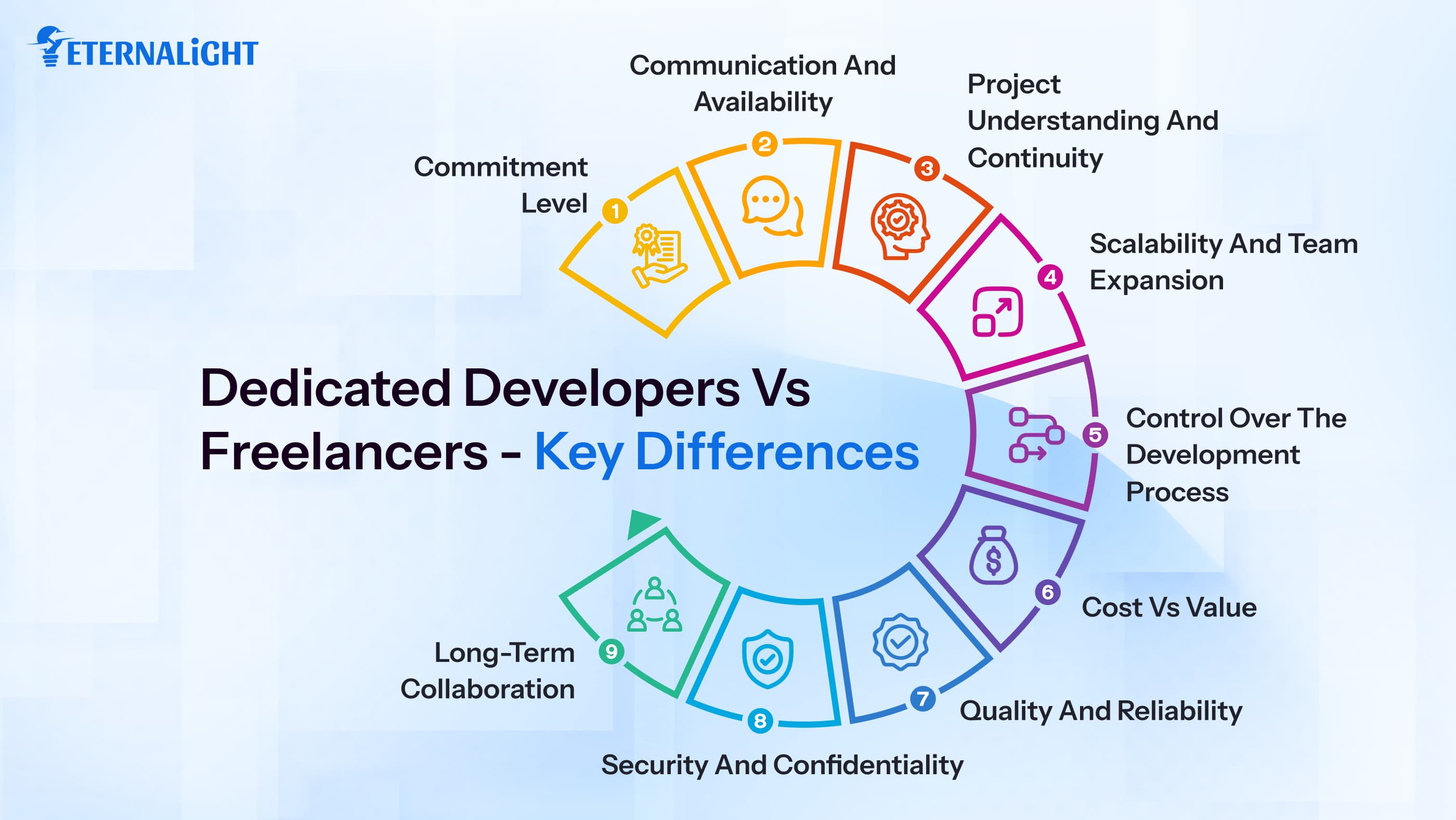
Understanding the real difference between these models goes beyond cost. It’s about how they fit into your project structure.
Commitment Level
Dedicated developers are fully assigned to your project. They treat your product as their primary responsibility, which naturally brings more focus and accountability. Over time, they also develop a deeper understanding of your business logic, user needs, and long-term goals.
Freelancers, on the other hand, usually work with multiple clients at the same time. While many are highly skilled, their attention is divided. This can sometimes slow down progress, especially when priorities shift between projects.
Communication and Availability
With dedicated developers, communication tends to be more structured. They follow defined working hours, attend regular meetings, and stay aligned with your internal team. This makes collaboration smoother, especially when quick decisions are needed.
Freelancers often work in different time zones and follow their own schedules. While this flexibility can be helpful in some cases, it may also lead to delays in responses or difficulty in coordinating real-time discussions.
Project Understanding and Continuity
Dedicated developers stay involved throughout the project lifecycle. From initial planning to final deployment, they build strong familiarity with the product. This continuity helps reduce errors and improve overall quality.
Freelancers are typically brought in for specific tasks. Once their work is done, they move on. If you need changes later, you may have to re-explain everything or even hire someone new, which can slow down the process.
Scalability and Team Expansion
One of the biggest advantages of a dedicated team is scalability. If your project grows, you can easily add more developers with similar skill sets and maintain consistency in development.
Freelancers don’t offer the same flexibility. Managing multiple freelancers for different parts of a project can quickly become complex, especially when coordination between them is required.
Control Over the Development Process
Dedicated developers work as an extension of your in-house team. You have better control over task management, priorities, and workflows. This is especially important for projects that evolve.
Freelancers usually work independently. While this reduces your involvement in day-to-day tasks, it also limits your control over how the work is executed.
Cost vs Value
Freelancers are often seen as the more affordable option, especially for short-term work. You pay only for the specific task, which can be budget-friendly in the beginning.
Dedicated developers may seem more expensive upfront, but they often provide better long-term value. Their consistent involvement reduces rework, improves efficiency, and leads to a more stable product.
Quality and Reliability
With dedicated developers, quality tends to be more consistent because they follow your standards, tools, and processes. They are also more accountable for the outcome.
Freelancer quality can vary depending on experience and availability. While many deliver excellent work, maintaining consistency across multiple freelancers can be challenging.
Security and Confidentiality
Dedicated developers usually work under structured agreements and follow strict security protocols. This makes them a safer option for projects involving sensitive data.
Freelancers may not always follow the same level of security practices, especially if working independently without formal processes in place.
Long-Term Collaboration
If you’re planning to build and scale a product over time, dedicated developers offer a stable partnership. They grow with your project and contribute to its evolution.
Freelancers are better suited for short-term engagements. Building long-term continuity with them can be unpredictable.
Pros and Cons of Each Hiring Model
Here are some pros and cons of both hiring models -
Hiring Model | Pros | Cons |
|---|---|---|
Dedicated Developers |
|
|
Freelancers |
|
|
Businesses focusing on custom software development often prefer the dedicated developer model because it ensures continuity and a deep understanding of the product.
For long-term projects like building an enterprise software development team, dedicated developers consistently outperform freelancers on accountability, domain knowledge retention, and scalability.
For quick fixes or one-time tasks, freelancers can be a practical choice, but they may not always align with long-term business goals.
When Should You Hire Dedicated Developers?
Hiring dedicated developers makes sense when your project is not just a task, but something you’re planning to build, improve, and scale over time. This model works best when consistency, collaboration, and long-term thinking are important.
When your project is long-term and evolving
If you’re building a product that will continue to grow - like a web app, SaaS platform, or mobile application - you need developers who stay with the project. Dedicated developers understand the system deeply over time, which helps in making better decisions and reducing rework.
When you need strong control over development
If you want visibility into what’s happening daily, dedicated developers are the right choice. They follow your workflows, attend your meetings, and align with your priorities. This level of control is especially useful when requirements keep changing.
When your project is complex
Complex projects often involve multiple features, integrations, and dependencies. In such cases, you can’t afford miscommunication or gaps in understanding. A dedicated team works together, ensuring everything is connected properly instead of being handled in isolated parts.
When collaboration matters
If your internal team (designers, product managers, or stakeholders) needs to work closely with developers, dedicated resources make collaboration smoother. They become part of your day-to-day process rather than external contributors.
When you plan to scale your product
Growth brings new requirements - more features, improved performance, and faster delivery. With a dedicated team, you can scale effortlessly by adding more developers without disrupting your existing workflow. This is where models like IT staff augmentation become highly valuable.
When quality and consistency are critical
If your product directly impacts your business reputation, you need consistent quality. Dedicated developers follow your coding standards, testing processes, and long-term vision, which results in a more stable product.
When you are investing in custom solutions
For businesses working on custom software development, having a dedicated team ensures that the product is built exactly according to business needs, rather than using a one-size-fits-all approach.
When Should You Hire Freelancers?
Freelancers are a good option when your needs are short-term, clearly defined, and don’t require ongoing involvement. They bring flexibility and speed, which can be very useful in the right situations.
When your project is small and well-defined
If you already know exactly what needs to be done - like creating a landing page, fixing bugs, or adding a small feature - freelancers can handle it efficiently without much coordination.
When you need quick results
Freelancers are often available to start immediately. If you have an urgent task and don’t want to go through a long hiring or onboarding process, this model works well.
When you’re working with a limited budget
For startups or early-stage ideas, hiring a full team may not be practical. Freelancers allow you to get work done at a lower initial cost, especially when the scope is small.
When you need a specific skill temporarily
Sometimes, you don’t need a full-time developer, just someone with a niche skill for a short duration. Freelancers are ideal for this kind of requirement, whether it’s design, testing, or a specific technology.
When ongoing collaboration is not required
If the task doesn’t need continuous updates or team involvement, freelancers can work independently and deliver results without regular interaction.
When you want flexibility in hiring
Freelancers give you the freedom to hire, pause, or switch resources quickly based on your needs. This flexibility can be helpful when you’re experimenting or testing ideas.
Why Choose Eternalight Infotech for Hiring Dedicated Developers?
When it comes to building reliable and scalable digital solutions, having the right development partner makes all the difference.
Eternalight Infotech focuses on providing experienced developers who align with your business goals, not just your technical requirements. Their approach goes beyond coding - they emphasize collaboration, transparency, and long-term value.
With expertise in team augmentation, businesses can easily extend their capabilities without the complexities of traditional hiring.
They also offer services across multiple domains, including custom software development and AI development, making them a strong choice for companies looking to innovate and scale.
For businesses exploring hiring strategies, insights into how to build a dedicated development team for your project can further help in making informed decisions.
Conclusion
There’s no one-size-fits-all answer in the debate of freelancers vs dedicated developers. The right choice depends on your project size, budget, timeline, and long-term vision.
If you need flexibility and quick execution for small tasks, freelancers are a practical option. But if your goal is to build a scalable, high-quality product with consistent progress, dedicated developers are the better investment.
In many cases, businesses start with freelancers and gradually move to dedicated teams as their projects grow. Understanding your needs clearly will help you make the right decision from the beginning.

Kusum Sethiya
Software Engineer
Kusum Sethiya is a Software Engineer at Eternalight Infotech, focused on building clean and intuitive. She enjoys turning ideas into reliable applications using modern technologies like Javascript, React, Node.js , and MongoDB.
Frequently Asked Questions
Dedicated developers work exclusively on your project, while freelancers handle multiple clients and usually work on short-term tasks.
Yes, initially they may cost more, but they provide better consistency, scalability, and long-term value.
Freelancers are ideal for small, short-term tasks that don’t require ongoing collaboration or deep involvement.
Yes, scaling is easier with dedicated teams as you can add or reduce resources based on project needs.
Startups often begin with freelancers for cost reasons, but shift to dedicated developers as they grow and need stability.
Related Blogs
 Project Management15 Mins
Top IT Staff Augmentation Companies in India
Discover the top IT staff augmentation companies in India, understand how IT staff augmentation works, explore its benefits, and learn how to choose the right partner to scale your development team efficiently.
.jpg&w=3840&q=75) Project Management12 Mins
Project Management12 MinsWhat is IT Staff Augmentation and How Does It Work?
A complete guide to understand IT staff augmentation, its benefits, process, and when businesses should use it for faster and smarter growth.
 Project Management10 Mins
How to Build a Dedicated Development Team for Your Project
A guide to building a dedicated development team for your project. Learn when to hire a dedicated development team, the roles you need in your team and the advantages of it.
