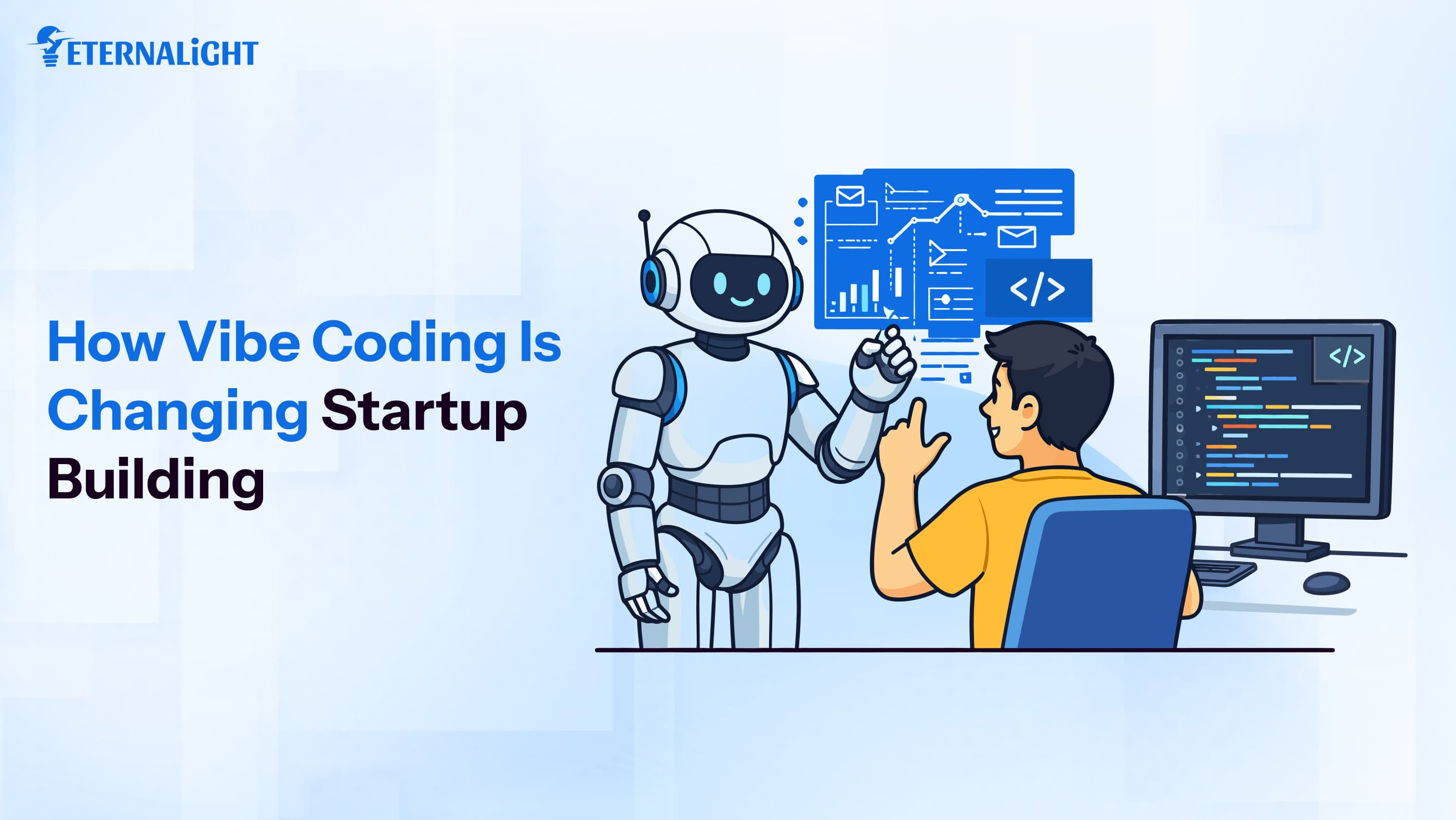
Developing an AI-driven digital solution isn’t easy for a non-technical person; that's why most startup founders look for a CTO who understands the trends and technical aspects needed to navigate the project. But it somehow increases startups' budgets due to its influential position.
Now, with the emergence of AI coding tools and vibe coding, the dynamics have changed. The way the development team used to work a few months back has just transformed. This blog reflects the impact of vibe coding across startups.
What is Vibe Coding and Why is It Trending?
It’s an AI-driven era, where developers use AI coding tools and platforms to finish and ship projects faster. Cursor, Lovable, Claude, Gemini, Replit, and many other tools have made this battle easier, with less friction and faster outcomes, leading developers to adopt vibe coding tools and AI-assisted development.
The shift from ChatGPT to Cursor was revolutionary: while ChatGPT can generate only a few code snippets for a given problem, Cursor has become a coding companion that can build components, handle errors, manage state, and ensure accessibility. It’s making coding more fun and exciting, completing tasks in a fraction of the time that usually takes hours of effort.
In short, the transformation is favorable for engineers at all levels, improving productivity, efficiency, and accuracy.
From Traditional Development to AI-powered Vibe Coding
AI tools can resonate with your idea and rebuild exactly what you want in reality. You can pick tools like Claude Code, Lovable, Replit, Gemini, and Cursor, and write in simple terms, explaining the features and functionalities you want.
Share the guidelines, audience, user persona, and USP. These apps can prepare the codebase and turn it into a fully functional app. It’s not rigid. You can make changes with CI/CD as much as you want.
Here, you are just issuing commands to the Vibe coding tools rather than writing code lines manually for modern AI startup development projects.
Why Founders are Adopting Vibe Coding?
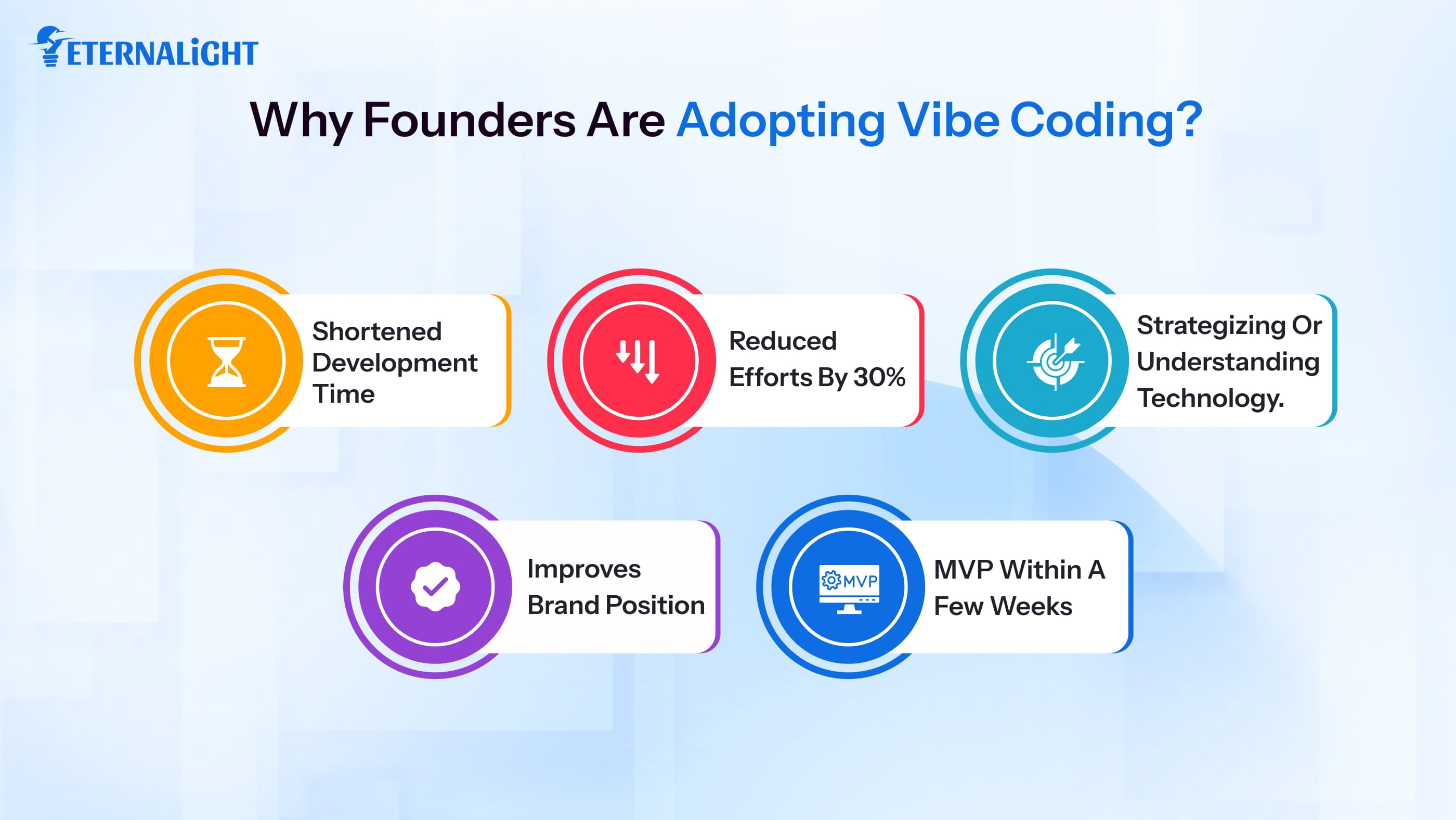
Whether it's a single-page or multi-page, domain-specific app, these AI-driven tools can prepare it with all dependencies, backend data via database connections, and appealing aesthetics. These tools have shortened development time and extended capabilities for all groups, from beginner to expert developers.
Many top tech giants, including leaders from Meta, Microsoft, and Google, have acknowledged that these AI coding tools have reduced their efforts by 30% and will continue working with them.
Founders are solely responsible for making decisions about what they want, and these tools handle the technical work. These tools have somehow replaced the urgent need for CTOs to guide non-technical founders in strategizing or understanding technology.
For AI powered MVP development, for any industry, founders can successfully validate and ship an idea with an MVP within a few weeks, rather than wasting months collaborating with freelancers or an outsourcing team.
With the evolution of technology, the level of competition is cut throat, and founders are working hard to maintain their brand position. With these tools, they can manage it more effortlessly.
The Reality Check!
Let's assume a founder wants to launch their app to showcase products and services, with all the features needed to scale their business and improve conversions and customer relationships.
A few years back, they used to hunt for top software development companies for their products. Generally, the software development company calculates the cost based on the efforts of its team members in designing the prototype, framing, deployment, quality assurance, release, and post-development support.
Now they have tools like Cursor, Replit, Claude, and ChatGPT to turn an idea into code and then the functional product by themselves. It saves their time, budget, and, of course, energy for product validation, so their customers can reach out and share orders and queries without much rush.
They don’t need UI/UX designers, developers, or QAs, or a project manager who can stretch the development cycle.
Why Technical Expertise Still Matters in AI-Led Development?
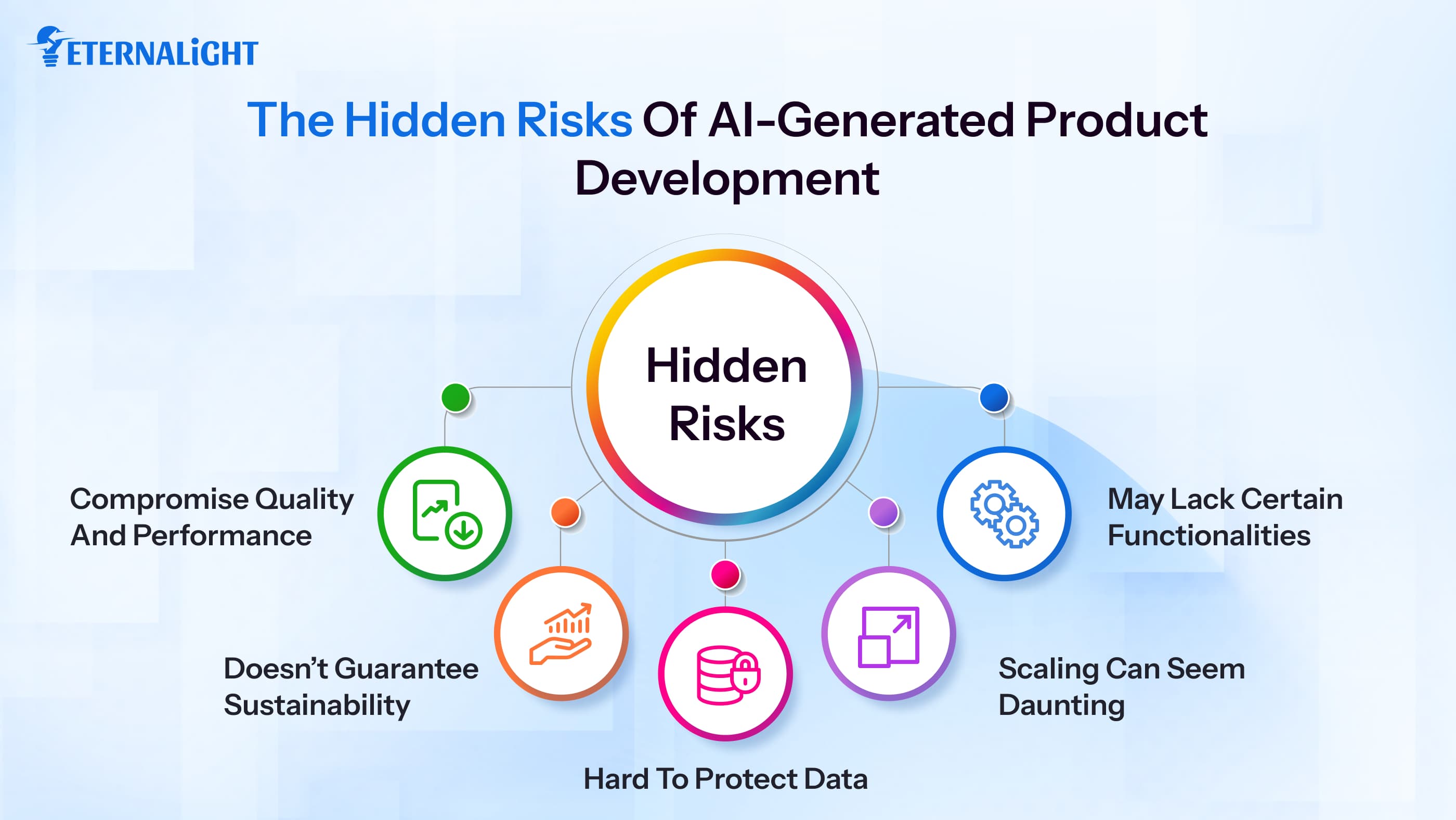
To turn the idea into a well-functioning, dynamic product immediately, vibe coding works well, but for scalability, it falls short. Non-founders may only know the idea but remain unaware of the behind-the-scenes practices and the approach required to bring it to life. For that, they must have knowledge of technical concepts, syntax, language understanding, and architectural design; otherwise, it becomes difficult to add future implementations.
One challenge of vibe coding is that AI coding tools may overrate code quality, leading to a messy, cluttered codebase. In case of any technical glitch or error, a non-technical person can’t detect or troubleshoot it. Until they understand the root cause of the product not working, they are unable to make changes or issue commands to improve it further.
If the idea and information are confidential, a breach can occur, and the output may be compromised. With AI-driven tools and live coding, you can build the idea from scratch, but scaling it still requires technical expertise.
Vibe Coding vs Traditional Startup Development
To understand the clear difference between traditional and vibe coding setups, see the table below. You can take a glance and instantly understand how vibe coding enables a quick MVP launch, ditching lengthy development cycles and the large workforce required in mobile app development teams. Founders can use AI-driven tools and structured workflows to experiment with and validate ideas faster.
Traditional Development | Vibe Coding Development |
Stick to the long development path | Rapid product validation (MVP) |
Dependency on development experts | Lean development with AI assistance |
Takes a long time to prepare the codebase manually | Needs a clearly defined prompt |
Excessive budget to hire team resources, and tools | Reduces budget overhead and enables frequent experimentation |
A lot of time and budget get swamped during prototyping | Instant MVP launch |
Best Practices for Startups Using Vibe Coding
In vibe coding, multiple AI tools and assistants work together to streamline the exhausting research process and accelerate product development. However, to unlock the full potential of vibe coding, founders must learn how to write clear prompts and communicate ideas precisely.
To make the most successful here are the vibe coding best practices:
- Understand your requirements and how you want to validate the product.
- Be clear about the organization's values to align with the vision and craft a narrative. How will it impact the future and also leave room for improvements?
- Beyond just motivational and innovative ideas, be mindful of the strategy and emotional resilience that connect to the pain point, aiming to achieve it with enthusiasm and a structured, milestone-based workflow.
- Avoid cognitive biases by reviewing different perspectives, assumptions, methods, and other brainstorming strategies.
- Use AI tools and models to plan and validate strategies, take action, analyze patterns and context, and perform risk assessment to rapidly generate output feedback.
- No need to participate in a long, time-consuming sprint plan; be smart, think innovatively, and test the concept first with a prototype design. Involve the stakeholders to gather suggestions and make the necessary iterations.
- Be ready for uncertainty and have a flexible backup plan to eliminate the obstacles. Always keep learning and incorporate it into your projects.
The Rise of AI-Native Startups and Solo Founders
Vibe coding has become an enabler of growth for solo founders. They can turn strong ideas into reality with less technological expertise and launch products independently without outsourcing to a software development partner. This shift has reduced dependence on CTOs and on long development sprint plans. Even with a smaller workforce, it is now possible to launch ideas by leveraging AI-driven tools and lean, AI-assisted execution.
Final Words
From months of coding to minutes of milestone achievement, the impact of vibe coding has entered and transformed founders’ lives. It has made the startup journey easier by reducing hiring costs, development timelines, and infrastructure expenses.
Whether it’s well-established businesses or early-stage startups, AI-driven tools and vibe coding have unlocked domain-specific opportunities across industries.
It has accelerated planning, development, and product launches while assisting in experimentation. At the same time, it has improved founders’ understanding of their product vision and encouraged experimentation with new ideas to create measurable business impact.

Ayushi Shrivastava
Senior Content Writer
Ayushi is a Content Strategist at Eternalight Infotech with 4 years of experience in transforming complex ideas into clear, engaging, and SEO optimized narratives. She specializes in crafting impactful content strategies that enhance brand visibility and drive meaningful engagement across digital platforms.
Frequently Asked Questions
If founders already have a clear product vision, they can use AI coding tools to turn their ideas into reality faster. It reduces dependency on large software development teams while saving time, budget, and resources during MVP development. Founders can instead focus more on marketing and business growth.
Enterprises can use vibe coding during the early stages to validate ideas and build projects with a limited scope. However, if the product needs to scale in the future, experienced engineers are still required to handle security, compliance, integrations, and long-term development.
Solo founders already manage operations, finance, hiring, and client communication on their own. A significant amount of time and budget goes into handling these responsibilities and managing employee costs. That’s why many founders are experimenting with vibe coding tools to reduce software development expenses and launch products faster.
Related Blogs
- AI & ML7 Mins
Best Prompt Engineering Techniques for AI Agent Systems
Explore prompt engineering techniques for different AI use cases, including structured prompts, zero-shot, few-shot, multimodal inputs, security, and testing.
- AI & ML10 Mins
AI Doesn't Forget. It Loses Context: How Context Graphs Can Help
Learn how context graphs help AI agents connect information, retain context, and make better decisions with AI memory tools and retrieval systems.
- AI & ML10 Mins
How to Test Generative AI Applications: A Practical Guide to Reliable AI Systems
Learn how to test generative AI applications for accuracy, hallucinations, performance, security, RAG workflows, and reliability.